
ALL EDITIONS
26 published editions and counting
Showing 26 editions
What should stay onchain? A builder’s guide to Vitalik’s Ethereum vision
One fictional payment, nine ways to test it, and three concrete integration ideas. Explore what evidence can establish and what your application still needs to enforce.

Launch a tokenized asset. Handle what happens after the trade.
Map issuer rules, corporate actions and redemption records. Start with the events your tokenized product must explain after the first transaction.

Test who can move the money before you ship the wallet.
Turn a custody approval policy into repeatable cases. Check independent approval, destination restrictions and the alternative paths that can move assets.

Put stablecoin payments on a budget your team can enforce.
Define limits, reserve capacity and handle uncertain results. A practical starting point for building a controlled stablecoin payout workflow.

Joining a tokenized-deposit network? Map the integration first.
Follow a fictional deposit request from authorization to network confirmation. Identify the ownership and recovery decisions your bank and vendor need to settle.

5 Banking Integrations to Try with AI Agents and Web3
Five banking ideas. Five working simulations. Try agent-operated accounts, payment routing, tokenised treasury, permissions and reconciliation—then inspect the integration logic.

Bring money onchain. Keep your books in sync.
Trace a payment across provider events and internal records. Then test duplicates, delays and mismatches before they become an operations problem.
Vitalik's wallet proposal could change your Ethereum stack. Here's how.
Compare today's smart accounts with EIP-8141: native validation, explicit transaction groups and per-frame receipts. Then break a vault deposit in our interactive lab.

Your audit is in 8 weeks. Your lead engineer just left. What now?
An eight-week audit window is 56 days. Median time-to-fill is 39—and that stops at offer acceptance. We mapped what a crypto team can still do before the code freezes.
BlackRock, Visa and Mastercard are about to run a blockchain together.
Circle named 11 financial institutions as Arc's founding validators. We mapped the new distribution-owned chain race—and built a test for whether anyone actually needs another chain.

AI agents are becoming paying customers. What should builders sell them?
Coinbase’s x402 lets software pay software without accounts or subscriptions. We mapped four products that could help agents choose, trust and buy—and built one.
Robinhood Chain is off to a huge start. Here's what's still missing.
Robinhood Chain reached $558M in DeFi TVL in seven weeks. Lending and trading filled up fast. We mapped where builders may still be early.
We scanned 50 Robinhood Chain contracts for unguarded minting. We found three. None were bugs.
Two Uniswap pools and an NFT sale, all three behaving exactly as designed. That turned out to be the more interesting result: spotting a risky-looking function is easy, judging the permissions around it is the hard part.
CoreDev Fund
Seed teams burn runway on token dumps and underpaid solo devs. What if senior dev pay locked to shipped milestones instead?
FocusVault
Hard technical problems need uninterrupted hours, and builders almost never get them. A prototype that makes deep work the default instead of the exception.
ContractBench
Most senior Solidity candidates can write a contract. Far fewer can design a protocol and defend it under attack. Here is a bench that tells them apart.
The 7 Questions a Smart Contract Audit Doesn't Answer
Euler passed ten audits from six firms, then lost $197M. Audits do their job. These are the seven questions they were never designed to answer.
RustEmbed
Sourcing a senior Rust engineer today puts them on your team next quarter. If your Solana launch window is this one, hiring is not the answer.

RealShip
Game and app founders pay for launch impressions and get bots. What if that budget routed to real players who actually show up and stay?
How We Shipped $1.7B Without an Exploit
USD0 went from private alpha to $1.7B TVL with zero critical exploits and a $16M bug bounty, the largest in web3. Here is how the engagement ran.

Single-Vendor Agent Risk
Blue Agent sat dead for 48 hours over a payment top-up. Production on-chain agents run on a single LLM gateway with no fallback. This is the fallback.

Agent Reputation Rails
AI agents can borrow, trade, and vote on-chain, but there is no credit score for an agent. Every protocol hand-rolls a policy that breaks once someone games it.
GCC-Compliant Tokenization Rails
GCC family offices hold $3T+ that wants on-chain RWA exposure, but every tokenization stack is US or EU-built and fails VARA and Sharia review out of the box.
Bug-Bounty-Ready in Weeks
A live bug bounty program with unresolved attack surfaces is not a safety net. It is an open invitation. The preparation is everything.
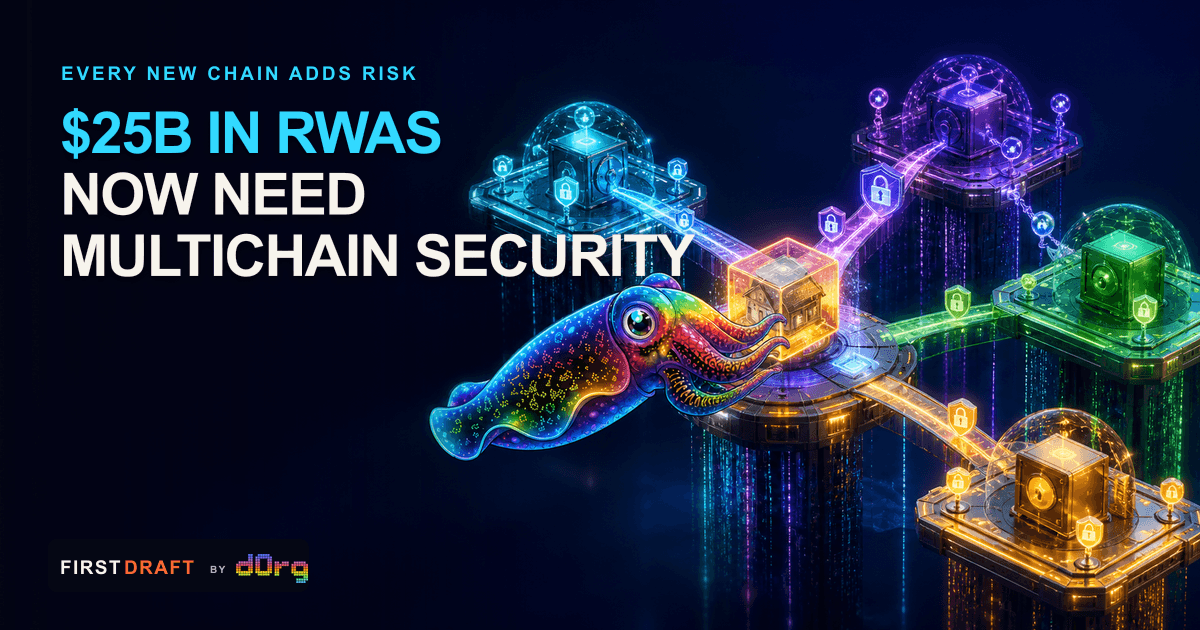
RWAs at $25B: The Per-Chain Audit Burden
Tokenized RWAs hit $25B and protocols are expanding to 4-6 chains. Every new chain is a fresh audit surface, and the cost compounds faster than teams plan for.

Solidity Talent Pool
A DeFi team that starts hiring a Solidity engineer today ships its MVP a quarter late. Here is the prototype for closing that gap without the search.