
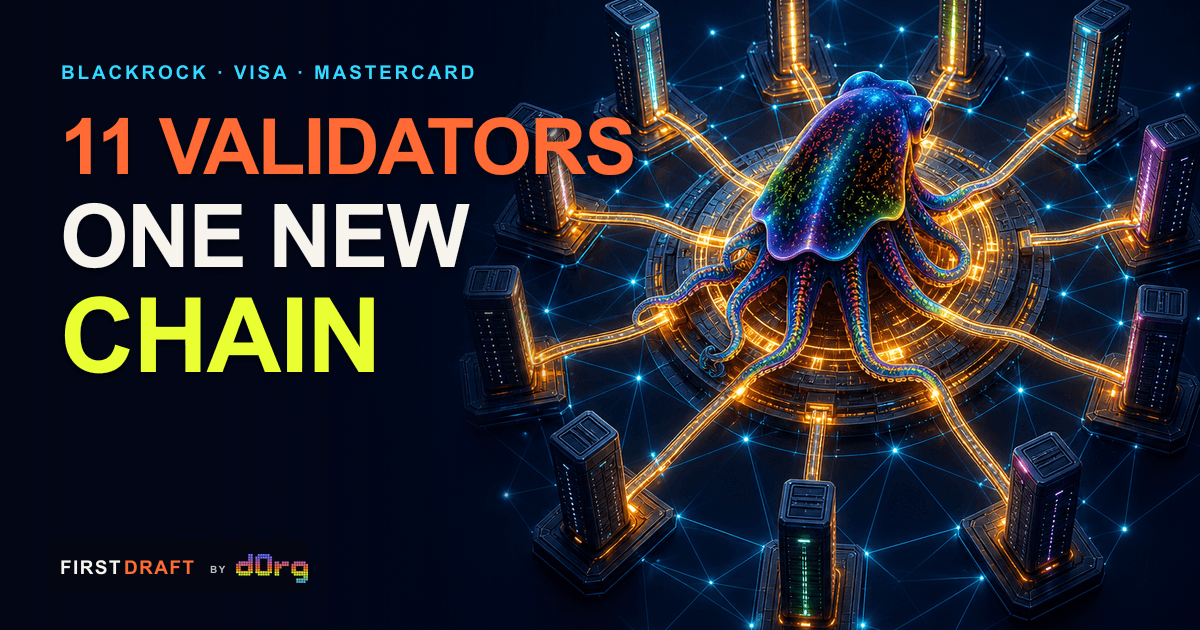
On September 16, Circle plans to open Arc to the public.
The founding validator cohort is not a list of anonymous infrastructure companies. It includes BlackRock, DTCC, Galaxy, Global Payments, ICE, Mastercard, MoneyGram, SBI, Standard Chartered, Sumitomo and Visa.
Eleven institutions that already sit inside global finance will validate a blockchain designed around stablecoin finance.
Circle also says more than 100 institutional and ecosystem participants are already building on private mainnet.
That is bigger than one launch.
The companies that own distribution are starting to own the rails
Coinbase has Base. Kraken has Ink. Robinhood has Robinhood Chain. Circle has Arc. Stripe and Paradigm have Tempo. Uniswap has Unichain. World has World Chain.
They use different architectures and governance models, and “own” means something different in each case. But the strategic pattern is difficult to miss.
These networks do not begin with a blank chain and hope users arrive. They begin with users, liquidity, assets, merchants or order flow—and build a chain around that advantage.
The competition is moving beyond transactions per second. It is becoming a competition over who can bring a captive distribution channel onchain.
The map
| Network | Sponsor | Built-in distribution | Stated center of gravity |
|---|---|---|---|
| Base | Coinbase | Exchange users and Base products | Onchain economy, markets, payments and agents |
| Ink | Kraken | Kraken clients and liquidity | DeFi |
| Robinhood Chain | Robinhood | Brokerage users and Stock Tokens | Onchain finance and RWAs |
| Arc | Circle | USDC and institutional network | Stablecoin finance |
| Tempo | Stripe + Paradigm | Merchant and payments network | Stablecoin payments |
| Unichain | Uniswap | DEX liquidity and interfaces | Crosschain liquidity |
| World Chain | World | World App and verified humans | Human-priority applications |
This table is not a maturity ranking. Some networks are live, Arc has an announced public launch date, and their permission and validator models differ. The shared variable is distribution.
Why Arc makes the shift obvious
Circle's launch announcement names the validator cohort and integrations ahead of the planned public mainnet.
The validator role matters: these organizations will participate in operating and securing Arc at launch. It does not mean that each institution controls the network, endorses every application or guarantees adoption. “Founding validator” is the precise claim.
Still, compare this go-to-market with a normal new chain. Arc does not need to begin by convincing the world that stablecoins matter. Circle already issues USDC, already serves institutions, and already has integrations across the financial stack.
Its launch question is not “can we attract a use case?” It is “which financial flows benefit from moving onto a rail designed around our existing network?”
That is a much stronger starting position.
Distribution changes the chain thesis
Base can reach Coinbase users. Ink can connect Kraken clients to DeFi. Robinhood can make tokenized equities composable. Tempo can meet payment companies where stablecoin settlement becomes operational infrastructure. World Chain can prioritize applications serving verified people.
None of that guarantees product-market fit. Distribution can move the cold-start problem; it cannot erase it.
It also creates new questions:
- Is the network neutral enough for competitors of its sponsor?
- Which components are permissionless and which require a relationship?
- Can outside builders reach the distribution channel, or only deploy beside it?
- Who controls upgrades, sequencing and the validator set?
- What happens when compliance policy and composability disagree?
The chain is not valuable merely because a recognizable company launched it. The useful advantage has to survive contact with an outside builder.
Where we'd look first
1 — Products native to the distribution channel
Do not copy a generic DeFi product onto every branded chain. Start with what the sponsor can uniquely bring: brokerage assets on Robinhood, merchant flows on Tempo, stablecoin treasury infrastructure on Arc, exchange liquidity on Base or Ink, and verified-human coordination on World Chain.
2 — Cross-network orchestration
If every distribution owner launches its own rail, users will still need to move identity, liquidity, policy and intent between them. The fragmentation problem does not disappear; it changes shape.
3 — Compliance-aware composability
Institutional networks need controls, but applications still need predictable interfaces. Identity, policy proofs, permission boundaries and auditable execution can become reusable infrastructure rather than product-specific plumbing.
4 — Credible-neutrality tooling
Teams choosing a network need evidence about upgrades, downtime, censorship, sequencing and bridge risk. A branded chain creates demand for independent observability precisely because the sponsor has an obvious commercial interest.
Before launching another chain, answer one question
What must happen at the protocol layer that cannot be achieved with contracts on a network that already exists?
Custom ordering can be an answer. Protocol-level privacy or compliance can be an answer. Sovereign upgrades, validator policy or economics can be answers. “We want our logo on a block explorer” is not one.
Running a chain means permanently owning bridges, data availability, upgrades, monitoring, indexers, liquidity programs, incident response and governance. The burden survives after the launch campaign ends.
What we built
Chain or Contract? turns that question into a small decision lab.
It maps the seven networks by distribution thesis, then asks six questions: whether the team controls a meaningful channel; needs custom ordering; requires protocol-level privacy or compliance; materially depends on chain economics; needs sovereign rules; and can prove an existing chain cannot satisfy the requirement.
The result is deliberately blunt: deploy contracts, prove the gap first, or a chain may be justified.
The score is a heuristic, not science. Its job is to expose weak assumptions before a team commits to permanent infrastructure.
The Arc launch file also keeps the 11 founding validators and the unanswered builder questions on one screen. The names create attention. The operating model determines whether that attention becomes an ecosystem.
What this is not
This is not a claim that every company needs a chain, that institutional validators make a network safe, or that captive distribution guarantees usage.
It is not a prediction that one architecture wins.
It is a snapshot of a strategic change. Crypto spent years asking new networks how they would acquire users. The next cohort increasingly arrives with users, assets or flows already attached.
That makes the opportunity more concrete—and the architecture test more demanding.
If distribution is the reason to own the rails, builders need to know whether they can actually reach it.