
🏛 RWAs at $25B: The Per-Chain Audit Burden
Tokenized RWAs hit $25B and protocols are expanding to 4-6 chains. Every new chain is a fresh audit surface, and the cost compounds faster than teams plan for.
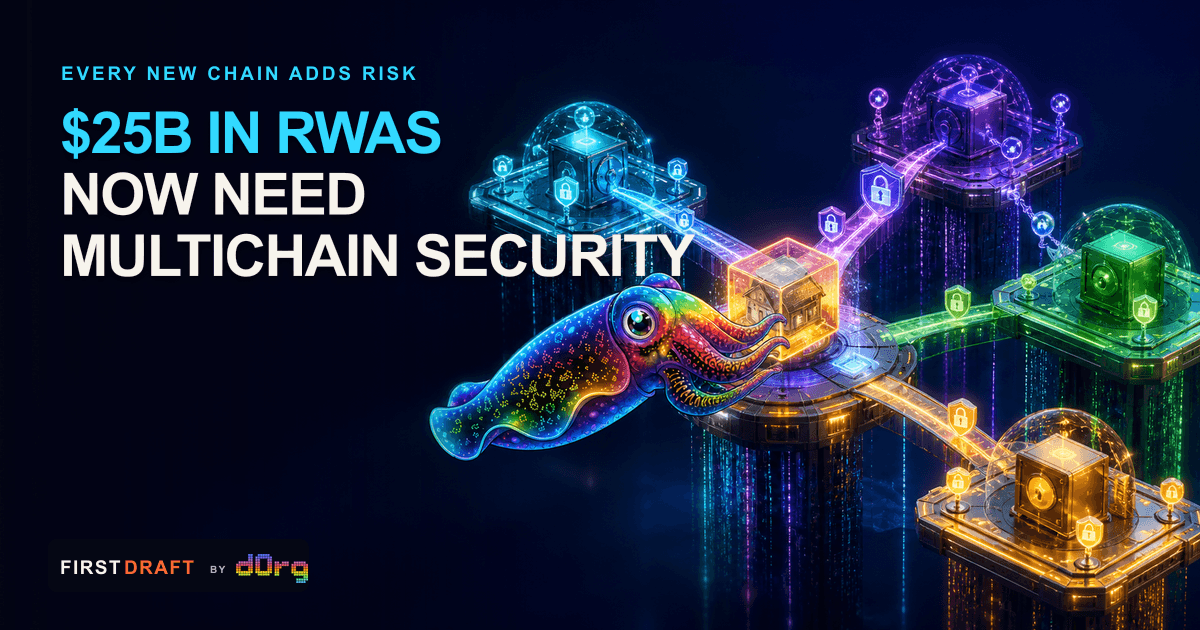
The 60-second brief
Research + working prototype by dOrg
By Q4 2026, RWA protocols partnering with us ship on 6+ chains with the same zero-exploit reputation they have on their home chain. dOrg becomes the named security partner referenced in their institutional pitch and audit reports.
Foundry invariant + fuzz suite reused across every chain deployment
Internal audit checklist as code (Slither, Echidna, custom invariants)
GraphQL subgraph templates for transparency on chain N
Oracle integration patterns (Chainlink Price Feeds plus Proof of Reserve)
The Problem
RWA protocols crossing $1B TVL on their home chain are scaling to 4-6 additional chains in 2026. Every new chain is a fresh audit surface and a fresh integration with new custodians, oracles, and exchanges. The single-firm, multi-month audit window that worked at $1B does not scale to chain N + 1 + 2 + 3 in parallel. Without a repeatable per-chain security primitive, expansion stalls or worse.
Who feels it
Engineering organizations behind any RWA protocol that has crossed $1B TVL on its home chain and is expanding to two or more additional chains in 2026.
Why now
Tokenized RWAs went from roughly $7B in early 2025 to about $25B by Q1 2026 (CoinGecko RWA Report). Institutional integrators (custodians, oracle providers, regulated exchanges) are setting their listing bar at audited posture per chain, not per protocol. Q3 2026 is the window to lock in repeatable security primitives before the inflection accelerates further.
Market size
Roughly $25B in tokenized RWAs across public chains by late Feb 2026 per CoinGecko. Tokenized US Treasuries alone exceed $9B; BlackRock's BUIDL fund holds $1.7B as of May 2026.
The Solution
What it does
Foundry invariant + fuzz suite reused across every chain deployment
Internal audit checklist as code (Slither, Echidna, custom invariants)
GraphQL subgraph templates for transparency on chain N
Oracle integration patterns (Chainlink Price Feeds plus Proof of Reserve)
Audit-ready dossier auto-generated from CI for external firm intake
Bug bounty framework with severity-mapped payouts ready before launch
Business Model
Embedded engagement scoped to the chain-N integration window, with smaller follow-on engagements for subsequent chains. Margins improve as test scaffolding and audit-orchestration patterns compound across deployments.
End Goal
By Q4 2026, RWA protocols partnering with us ship on 6+ chains with the same zero-exploit reputation they have on their home chain. dOrg becomes the named security partner referenced in their institutional pitch and audit reports.
Don't just read the thesis
See what happens when the idea has to work.
A working demo runs the audit-orchestration playbook against a mock RWA mint contract, surfacing green/red invariants and producing the auditor-intake PDF in CI. Honest limitation: external firm audits still happen, but the artifacts they need are produced in days, not weeks.
Simulated where noted. No wallet, transaction or purchase is required.
Have a version of this problem?
A senior dOrg engineer will review the architecture, assumptions and risks. A few minutes. No pitch.
Where this came from
6 public signals behind this edition.
“It is coming. The largest platform for tokenized stocks and ETFs is coming to @Solana in early 2026. Wall Street liquidity meets internet capital markets.”
Why it fits: A flagship RWA protocol publicly committing to a second-chain expansion - exactly the timing trigger that makes repeatable per-chain audit posture urgent across the segment.
“Detangling Tokenization of RWAs: as institutional issuers expand on-chain, the bar for security, compliance, and per-chain auditability has risen sharply. Repeatable security primitives are the difference between scaling and stalling.”
Why it fits: TradFi heavyweight explicitly naming repeatable security primitives as the segment's scaling constraint - exactly what the playbook delivers.
“RWA Prediction 2026: Proof-Carrying Compliance and the Future of Standardized RWA. Every new chain integration without invariant proofs is a future exploit. The protocols that ship audit-ready posture per chain will own the institutional flow.”
Why it fits: Names the exact failure mode an RWA protocol's multi-chain expansion hits without a repeatable per-chain audit posture.
“Tokenized assets are moving deeper into financial workflows. Sandy Kaul, Head of Innovation at @FTDA_US, says onchain RWAs are proving "highly effective" as collateral for financing and derivatives. RWAs are becoming productive collateral across yield, financing, and trading.”
Why it fits: Validates the institutional appetite the segment is scaling into: collateral use cases that demand zero-exploit posture across every chain a protocol touches.
“2026 is shaping up as the year of RWAs. Tokenized assets have crossed $21B+ TVL, with projections pointing to $400B+ by year-end. But here is the trillion-dollar question: if an asset is not verifiably real and compliant on chain, is it truly tokenized or just another promise?”
Why it fits: Calls out exactly the gap dOrg's playbook closes: verifiability and compliance posture per chain, not just per protocol.
“Real World Assets (RWA) are here. In 2026, Crypto is not just Bitcoin. It is the plumbing for finance: TreasuryBills are tokenized on-chain. Real estate liquidity is instant via fractional tokens. Institutional money (BlackRock, Fidelity) has officially replaced the degens.”
Why it fits: Captures the institutional inflection (BlackRock, Fidelity) that puts RWA protocols under direct comparison to TradFi standards.
Working on something like this?
Tell us what you're building and a senior dOrg engineer will read it and send back an honest take on scope and risks. A few minutes, no pitch.
Just browsing? Get the next edition by email
Previous
#1 Solidity Talent Pool
Next
#4 Bug-Bounty-Ready in Weeks