
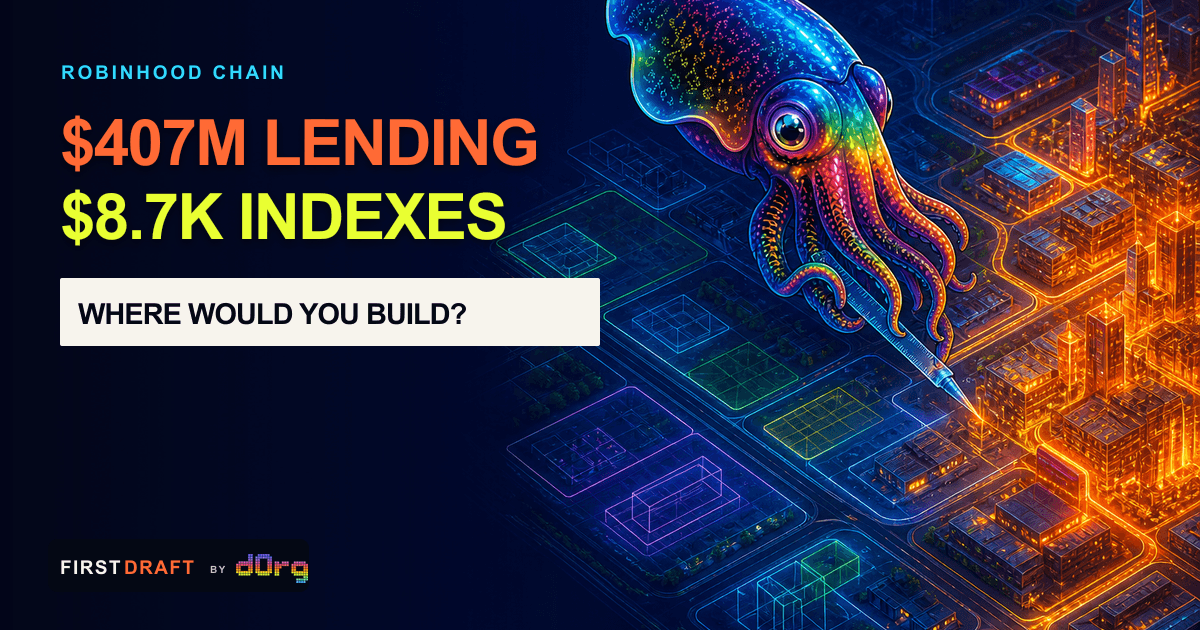
Robinhood Chain has been live for seven weeks. That is normally not enough time to say much about a new network.
This one moved faster.
In our August 19 snapshot it had already reached $557.9M in DeFi TVL, $678.8M in stablecoins and $511.8M of DEX volume in a single day. Whatever you make of Robinhood's blockchain bet, people are using it.
So the interesting question has changed. It is not whether Robinhood Chain can attract capital.
It is where that capital hasn't gone yet.
We mapped every category we could measure. Some parts of the chain are already surprisingly crowded. Others barely exist. Those are the ones we wanted to understand.
What we measured
Every figure below comes from DeFiLlama and was read on August 19, 2026, seven weeks after public mainnet. These numbers move. Check them before acting on them.
Established categories
| Category | TVL | Protocols |
|---|---|---|
| Lending | $407,806,108 | 3 |
| DEXs | $91,853,734 | 35 |
| Derivatives | $49,092,399 | 3 |
| Yield | $24,944,705 | 4 |
| Launchpads | $5,769,315 | 27 |
Thin categories
| Category | TVL | Protocols |
|---|---|---|
| Yield aggregators | $78,828 | 4 |
| AI agents | $36,849 | 1 |
| Indexes | $8,679 | 2 |
| RWA lending | $152 | 1 |
One number needs a caveat before anything else. Summing every category gives roughly $1.03B, while the chain reports $557.9M. The difference is largely Steakhouse Financial, categorised under Risk Curators while curating Morpho vaults whose capital is already counted under Lending. It is the same money. We use the deduplicated chain figure, because simply adding the categories together would count part of the chain twice.
Here is the whole thing on one screen. The first two blocks are measured. The third is not.
ROBINHOOD CHAIN — 7 WEEKS AFTER MAINNET

ESTABLISHED / MEASURED
  Lending                    $407.8M
  DEXs                        $91.9M
  Derivatives                 $49.1M
  Yield                       $24.9M
  Launchpads             27 protocols

THIN / MEASURED
  Yield aggregators           $78.8K
  AI agents                   $36.8K
  Indexes                      $8.7K
  RWA lending *                 $152

OPPORTUNITIES TO TEST
inferred, not measured — deliberately unranked
  Stock Token baskets
  RWA-native yield
  RWA safety infrastructure
  Agentic portfolio infrastructure
  Best-execution infrastructure

* DeFiLlama's RWA Lending category. Not necessarily
  every Stock Token lending product on the chain.
The obvious primitives filled up first
Lending is the clearest example. Roughly $407.4M of the lending total was Morpho Blue alone in our snapshot. That does not mean lending innovation is over. It means another generic money market is not where we would start looking for whitespace.
Trading tells a similar story. The chain had 35 DEXs, roughly $91.9M of DEX TVL and more than half a billion dollars of volume in a day. Stock Tokens also do not depend on a single liquidity model: Robinhood documents RFQ through aggregators, public AMMs, proprietary AMMs, direct mint and burn for authorised market makers, and orderbook trading. Several execution paths for the same class of asset.
And there were already 27 launchpads in the dataset.
Builders found many of the obvious primitives quickly. The interesting question is what comes next.
Where it gets strange
Robinhood's own developer documentation says Stock Tokens are designed to be composed into indices and baskets. Their example is almost comically specific: an AI basket containing NVDA, MSFT and GOOGL, valued through the tokens' price feeds.
Then look at the measurable application layer.
Index TVL: $8,679. Two protocols. One of them, Hood Index, held $81 in the snapshot.
Then consider RWA lending. This is a chain built around tokenized real-world assets. Yet DeFiLlama's RWA Lending category showed $152. One protocol.
Worth being precise about what that does and does not mean. We know what one category on one dashboard showed. That is not the same as every form of Stock Token lending, or every application on the network, and $152 is not proof that demand exists. What it is, is a striking gap between what the infrastructure was built to support and where measurable capital has gone so far.
Yield needs the same caution. Yield aggregators showed only $78,828, which looks absurd next to $407.8M of lending. But the chain also had a separate Yield category holding roughly $24.9M, almost all of it Spark Savings. So the honest version is narrower: there are already meaningful yield products here, and very little measured activity appears to be composing Stock Tokens into RWA-native ones.
That is more interesting anyway.
Where we'd look first
Four places where the primitives exist, Robinhood explicitly supports the use case, and the product layer is still small. We have drawn no bar for any of them, because there is no metric to draw.
1 — Stock Token baskets
Why now
Robinhood already provides the tokenized assets, the onchain infrastructure and the pricing components needed to compose equities into programmable portfolios. Their own docs use baskets and indices as the worked example.
What's missing
In our snapshot the entire Index category showed $8,679 across two protocols — extremely small relative to the rest of the ecosystem. That does not prove users want index products. It does mean the category is still unusually thin.
What we'd test
Something narrow and immediately understandable. An AI basket of NVDA, MSFT and GOOGL. A semiconductor basket. A dividend basket whose corporate actions are handled correctly. The experiment is not "can we tokenize equities" — that part is done. It is whether people want products composed out of them.
2 — RWA-native yield
Why now
The lending infrastructure is already deep: Morpho alone accounted for more than $400M of lending TVL in the snapshot. The primitive exists.
What's missing
The layer between those money markets and someone holding a Stock Token is much thinner. Yield aggregators showed around $78.8K, though the chain does have general yield products outside that category.
What we'd test
Not another money market. Something closer to: I hold tokenized equities, make those positions productive without requiring me to become a DeFi power user. A Stock Token vault could combine equity exposure with the lending infrastructure that already exists, while making the risks and the corporate-action behaviour explicit. A hypothesis, not a forecast.
3 — RWA safety infrastructure
Why now
Stock Tokens are standard ERC-20s. Valuing them like ordinary ERC-20s is the trap. Their feeds update 24/5 rather than continuously, so an integrator may need to check price freshness against a heartbeat, the state of the L2 sequencer, whether an oracle is paused, whether a corporate action is in flight, and which ERC-8056 multiplier is active or pending.
There are also two price surfaces with different meanings. Robinhood's REST API exposes the raw underlying-equity price; the Chainlink feed exposes the multiplier-adjusted token price. Mix them up and the valuation is wrong with nothing reverting to tell you why.
What's missing
Every vault, basket, portfolio engine, derivative, lending integration, accounting system and autonomous agent that touches these assets eventually has to solve some version of this. Today most of that logic gets written independently, inside each product.
What we'd test
A small integration layer that exposes something as conceptually simple as safePrice(NVDA) and handles the ugly RWA-specific conditions underneath. This is the one we picked to prototype.
4 — Agentic portfolio infrastructure
Why now
The chain ships with first-class account abstraction around ERC-4337 and EIP-7702, so programmable wallets, batching, spend policies, session-style permissions and automation are already available. Robinhood is moving toward agentic products. The rails exist.
What's missing
An autonomous financial agent should not just receive trade() and unlimited discretion. It needs a mandate: which assets it may touch, a daily turnover cap, a maximum position size, a requirement that the price is fresh and the oracle is not paused, no leverage, an expiry on Friday afternoon. The AI agents category held $36,849 across one protocol in our snapshot.
What we'd test
A portfolio agent whose autonomy lives inside an enforceable policy, with best execution underneath it. With several venues for the same Stock Token, the useful question stops being "where can I swap" and becomes "where should this specific order execute right now, after spread, price impact and fees". That layer can sit under wallets, portfolios and agents without any user knowing it exists.
What we built
We could have stopped at the map. Instead we picked one of the gaps and tried to build through it.
The moment we started on a Stock Token basket, the abstraction began to leak. A portfolio looks simple — 40% NVDA, 30% MSFT, 30% GOOGL — but before you can trust the NAV you have to know whether the data underneath it is valid.
That is how RWA Lens happened.
Composing the tokens is the boring part. Before it computes a dollar of NAV, RWA Lens checks that the sequencer is healthy, that every feed is fresh against its heartbeat, that no oracle is paused, that no multiplier change is pending, and which multiplier is currently active. If one of those fails it returns no valuation rather than quietly returning a questionable one.
One toggle makes the NVDA feed go stale and the NAV disappears. That is the whole first demo, and it takes five seconds to understand.
A second toggle simulates a dividend multiplier. The raw balance stays at 10.0000 while the share equivalent moves to 10.1240. The token balance did not change; the economic exposure did. An easy detail to miss.
It does not trade, hold custody, rebalance, handle tax, or fall back to a second oracle, and none of it has been audited. Those exclusions are deliberate. The point is not to pretend this is a product. It is to make one of the gaps in the map concrete.
What this is not
Not a claim that an $8,679 category becomes an $800M category. TVL is not product-market fit.
Not an exhaustive directory of everything running on this chain, either — a thin DeFiLlama category does not mean nobody is building there.
It is a snapshot. DeFiLlama tells us where measurable onchain capital sits. Robinhood's documentation tells us what the infrastructure was designed to support. The distance between those two is a hypothesis — and hypotheses are for testing.
Seven weeks is early, and that is the point. Once every obvious category is crowded this map stops being worth drawing. Right now the chain looks like it is in an unusual middle state: mature enough to build on, young enough that the application layer is still taking shape. That window will not stay open forever.